Swipe Right on Confusion: How Dating Apps Turned Romance Into a Three-Letter Obstacle Course
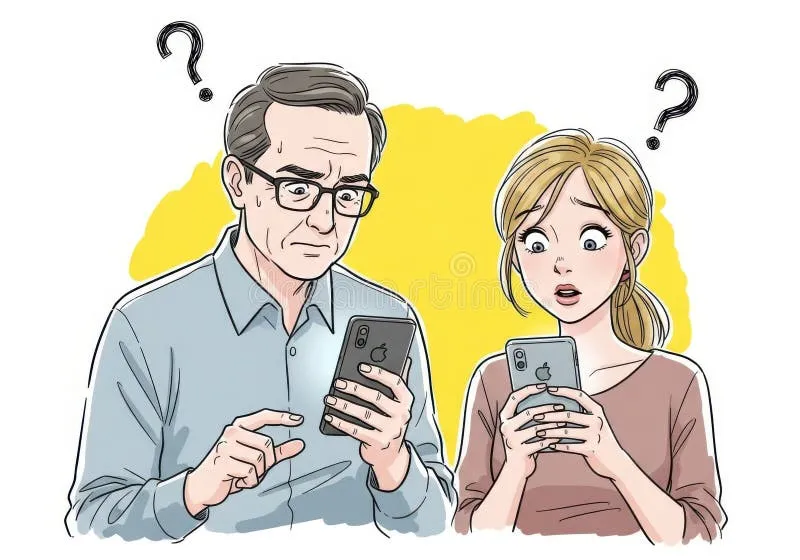
Photo: person confused looking at smartphone dating app profile, via thumbs.dreamstime.com
Somewhere between the invention of the printing press and the release of Tinder's first update, humanity decided that romance — that grand, sweeping, poetry-inspiring force — deserved to be compressed into three capital letters and shoved into a bio between someone's height and their controversial opinion about pineapple on pizza.
Welcome to modern dating, where your entire emotional availability can be summarized in an acronym and your future partner is expected to decode it before they even learn your last name.
Here at TPLBT, we traffic in letters. Too many of them, frankly. But even we weren't prepared for the sheer audacity of the dating app industrial complex, which looked at the English language — all 170,000-plus words of it — and said, "You know what? Three letters. That's enough. Figure it out."
The Alphabet of Desire (Or: What Your Dating Profile Is Actually Saying)
Let's set the scene. You're scrolling through a dating app at 11:47 PM, a bowl of cereal going soggy on your nightstand, and you encounter a profile that reads: "LTR only, no FWB, definitely not NSA, ENM-friendly, sapio preferred, HMU if you're DTF for something real."
Congratulations. You've just read a sentence that contains more acronyms than a Pentagon briefing and communicates approximately the same level of emotional warmth.
For the uninitiated — and no shame if you are, this stuff evolves faster than a streaming service cancels a show you liked — here's your cheat sheet:
- DTF: Down to... you know. The classic. The OG. The one your mom definitely knows about and pretends she doesn't.
- LTR: Long-Term Relationship. The romantic equivalent of saying "I'm not just here for the free breadsticks."
- NSA: No Strings Attached. Which, if we're being honest, always comes with at least a few strings. Maybe just one. A very thin one. But it's there.
- FWB: Friends With Benefits. The arrangement that has ended exactly zero friendships, according to absolutely no one.
- ENM: Ethical Non-Monogamy. The ethical part is doing a lot of heavy lifting in that acronym.
- HMU: Hit Me Up. Technically not exclusive to dating, but in this context it means "I am emotionally available and also slightly lonely on a Tuesday."
The explosion of this lexicon didn't happen by accident. Dating apps, by design, are optimization machines. They're built to filter, sort, and categorize human beings with the same energy that Amazon applies to warehouse inventory. Acronyms are the natural offspring of that philosophy — efficient, scalable, and completely devoid of the messiness that makes actual human connection interesting.
Liberation or Just a Fancier Way to Disappear?
Here's where it gets complicated, and also where the dating experts weigh in with takes that are simultaneously reassuring and deeply unsettling.
On one hand, the case for acronyms is genuinely compelling. Dr. Sarah Hensley, a relationship coach based in Austin who has spent the better part of a decade helping people navigate the app-dating landscape, argues that the shorthand serves a real purpose. "Before people had language for what they wanted," she explains, "they'd go on three dates before discovering they were fundamentally incompatible in terms of relationship goals. Now someone can put 'LTR only' in their bio and immediately filter out people who aren't aligned. That's not shallow — that's efficient."
And she's not wrong. There's something genuinely liberating about a culture that has created vocabulary for relationship structures and intentions that previously had to be negotiated through awkward conversations over bad restaurant wine. The rise of ENM as a recognized acronym, for instance, has given people in non-traditional relationship structures a shorthand that signals both their lifestyle and their expectation that a potential partner understand it before swiping right.
But then there's the other hand. And the other hand is holding a phone, typing "lol sorry been busy" to someone they've been on four dates with, because the NSA framework they established in week one has now given them a guilt-free exit ramp from something that was starting to feel like actual feelings.
"Acronyms can create a false sense of clarity," says Marcus Webb, a therapist in Chicago who specializes in digital-age relationship dynamics. "People think because they've labeled something — FWB, NSA, whatever — they've had the conversation. But a label isn't communication. It's a placeholder for communication. And when things get complicated, which they always do, the acronym doesn't hold."
In other words: three letters might get you on the same page at the start, but they won't stop the page from catching fire later.
The Ghost in the Machine (Learning to Disappear in Three Letters)
Perhaps the most insidious contribution of dating app acronyms to modern romantic culture is how they've industrialized the art of the exit. When you've established an NSA dynamic upfront, ghosting someone doesn't feel like abandonment — it feels like honoring the terms of the agreement. The acronym becomes a liability waiver for your feelings.
This is, to put it gently, a lot. To put it less gently: we've created a system where the language of romance has been optimized to make it easier to treat people like subscription services you can cancel without calling customer support.
Gen Z, to their credit, seems to be pushing back on this in real time. There's a growing counter-trend among younger daters who are deliberately verbose in their profiles — writing actual paragraphs, specifying not just relationship goals but values, dealbreakers, love languages, and occasionally their feelings about whether cereal counts as a soup. It's almost aggressively human in a landscape that rewards compression.
Too Many Letters, Not Enough Meaning
Here at TPLBT — a site that exists, let's be honest, because someone thought a string of letters could mean something, or at least could mean whatever you needed it to mean — we feel a certain kinship with the dating app acronym phenomenon. We are, after all, built on the premise that letters are infinitely flexible, that meaning is negotiable, and that sometimes a cryptic combination of characters is more interesting than a complete sentence.
But even we have to admit: there's a point where the compression goes too far. Where the shorthand stops being a convenience and starts being a wall. Where "DTF for something real" stops being an interesting contradiction and starts being a cry for help dressed up as a profile optimization strategy.
Romance, it turns out, is not a form you can fill out. It's not an API that two people can integrate if they just agree on the right parameters upfront. It is, frustratingly and wonderfully, a thing that requires actual words. Sometimes long ones. Sometimes embarrassing ones. Sometimes a whole paragraph about your feelings at 2 AM that you'll regret sending but will ultimately be glad you sent.
The acronyms aren't going anywhere. DTF will outlast most of us. LTR will keep appearing in bios until someone invents a dating app that reads your mind and spares everyone the trouble.
But maybe — just maybe — the next time you're composing your dating profile, you could throw in a complete sentence somewhere. A verb. A clause. Something that proves you are, in fact, a human person and not a very romantic piece of software.
Your future partner will appreciate it. Probably. Or they'll swipe left because you didn't mention you're ENM-friendly.
This is fine. Everything is fine. IYKYK.