Before the Internet Broke Language, Your Parents Were Already Doing It Wrong
Somewhere right now, a Boomer is watching their grandkid text "NGL fr fr no cap" and experiencing a level of confusion usually reserved for assembling IKEA furniture without the instructions. They're shaking their head. They're sighing. They're probably saying something like, "Why can't kids just talk anymore?"
And here's the thing: that Boomer almost certainly said "ASAP" six times before lunch today.
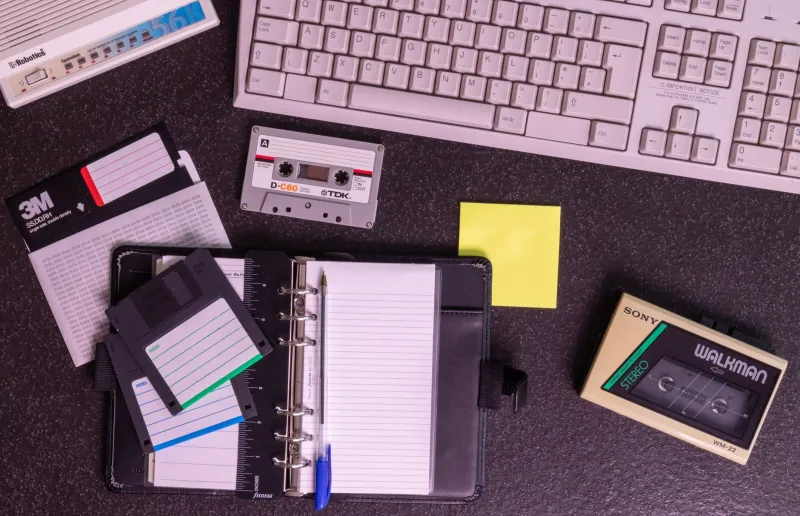
Welcome to TPLBT's deep excavation of pre-internet abbreviation culture — the archaeological site where we dust off the relics your parents' generation left behind and ask the genuinely uncomfortable question: Were Boomers and Gen X the original internet slang engineers, just working with worse technology?
Spoiler: absolutely yes. Strap in.
The Acronym Ancestors Nobody Talks About
Let's establish the timeline. The internet didn't invent abbreviations. The military invented abbreviations, which is honestly on-brand for an institution that turns everything into a process. RADAR (Radio Detection And Ranging) dates back to the 1940s. SCUBA (Self-Contained Underwater Breathing Apparatus) hit the scene around the same era. These weren't slang — they were engineering — but the instinct was identical to what Gen Z is doing today: take a long, annoying phrase and compress it until it fits on a patch or, eventually, a screen.
By the time the 1970s rolled around, acronym culture had fully infiltrated civilian life. ASAP (As Soon As Possible) became the universal battle cry of every middle manager who ever lived. RSVP — borrowed wholesale from French (Répondez s'il vous plaît) — was printed on every wedding invitation from Pasadena to Portland. Nobody questioned it. Nobody Googled what it meant. You either knew or you showed up to a dinner party that had already started without you, which was its own form of social punishment.
The point is: your parents were abbreviating constantly. They just did it on paper, over the phone, and in memos typed on machines that weighed forty pounds.
The Office Was a Slang Factory
If you want to understand where pre-internet abbreviation culture really thrived, look no further than the American workplace of the 1980s. Offices in that era ran on acronyms the way modern offices run on Slack notifications and existential dread.
FYI (For Your Information) was passive-aggressive long before passive-aggression became a TikTok personality type. CC (Carbon Copy) — yes, named after actual carbon paper — was the original subtweeting, a way to loop in your boss on an email chain while maintaining plausible deniability. EOD (End of Day) set deadlines. ETA gave people a timeline. TBD (To Be Determined) was the corporate way of saying "we have absolutely no idea but we'd prefer you didn't panic."
These weren't born from a desire to be cool. They were born from pure, unadulterated laziness dressed up as efficiency. Which, if we're being honest, is exactly the same energy behind "lol," "brb," and "idk." The motivation was identical. Only the medium changed.
Why Their Abbreviations Survived and Yours Won't
Here's where it gets interesting — and maybe a little humbling for the chronically online crowd.
ASAP is still in use. RSVP is still on invitations. SCUBA is still what you call the thing you do with tanks on your back in the ocean. These acronyms are decades old and show zero signs of retirement. Meanwhile, "IYKYK" peaked in 2021, and half the people reading this sentence are already not sure if it's still acceptable to use.
So what gives? Why do the old ones stick and the new ones evaporate?
A few theories, none of them particularly flattering to either generation:
Theory One: Utility over vibes. ASAP communicates urgency. RSVP requests a response. SCUBA describes a thing. They're functional. A lot of modern internet acronyms communicate a feeling or a social signal — which is valuable! — but feelings are contextual and social signals shift. Utility has a longer shelf life than irony.
Theory Two: Institutional adoption. Once something lands in a memo, a textbook, or a government document, it's basically immortal. The military, corporate America, and Emily Post-style etiquette guides cemented mid-century acronyms into the infrastructure of daily life. There's no equivalent institution gatekeeping "lowkey" or "slay." Which is both a freedom and a death sentence.
Theory Three: Nobody was watching the clock. Gen Z abbreviations exist in an attention economy where novelty is the product. The faster something spreads, the faster it gets overexposed, co-opted by brands, printed on a Kohl's T-shirt, and left to die on the side of a digital highway. Your grandfather said ASAP in 1987 and nobody put it on a tote bag. That anonymity was protective.
The Slang That Bridged the Gap
There's a fascinating middle period — roughly the late 1980s through the mid-1990s — where pre-internet and proto-internet abbreviation culture overlapped in genuinely chaotic ways.
Pagers gave us numeric codes: 143 for "I love you," 911 for emergencies, 07734 for the incredibly mature act of typing "hello" upside down on a calculator. Fax machines spawned a whole dialect of business shorthand. Answering machine etiquette produced its own set of unwritten rules about what you said and how fast you said it.
And then AOL Instant Messenger showed up in 1997 and blew the whole thing open. BRB. AFK. LOL. GTG. These weren't invented in a vacuum — they were the direct descendants of office memos and pager codes, now running at the speed of a 56k modem. Gen X didn't realize they were handing their younger siblings and eventual children a loaded linguistic weapon. They thought they were just telling someone they'd be right back.
What the Dig Actually Tells Us
Here's what you find when you actually put on the metaphorical archaeologist hat and sift through the linguistic sediment: every generation has abbreviated language to match the speed of their technology and the patience of their audience. Cave paintings were probably shorthand for something. Definitely.
The difference isn't the impulse — it's the infrastructure. Pre-internet acronyms got baked into institutions, which gave them longevity. Post-internet acronyms get baked into algorithms, which gives them reach but almost no staying power.
Your parents weren't immune to the urge to compress language. They were just working in a slower medium, which accidentally made their shortcuts more durable. There's something almost poetic about that. Or at least something worth texting your mom about — though she'll probably just reply with "K" and you'll spend the next four hours wondering what you did wrong.
ASAP, she needs to learn some new acronyms. The rest of us have moved on. Kind of.